
Infill Replenishment in Greater Houston
Restore thinning or displaced infill to keep your turf draining properly after Houston's heavy rains, feeling cushioned underfoot, and supporting blade structure through every wet season.
Get a Quote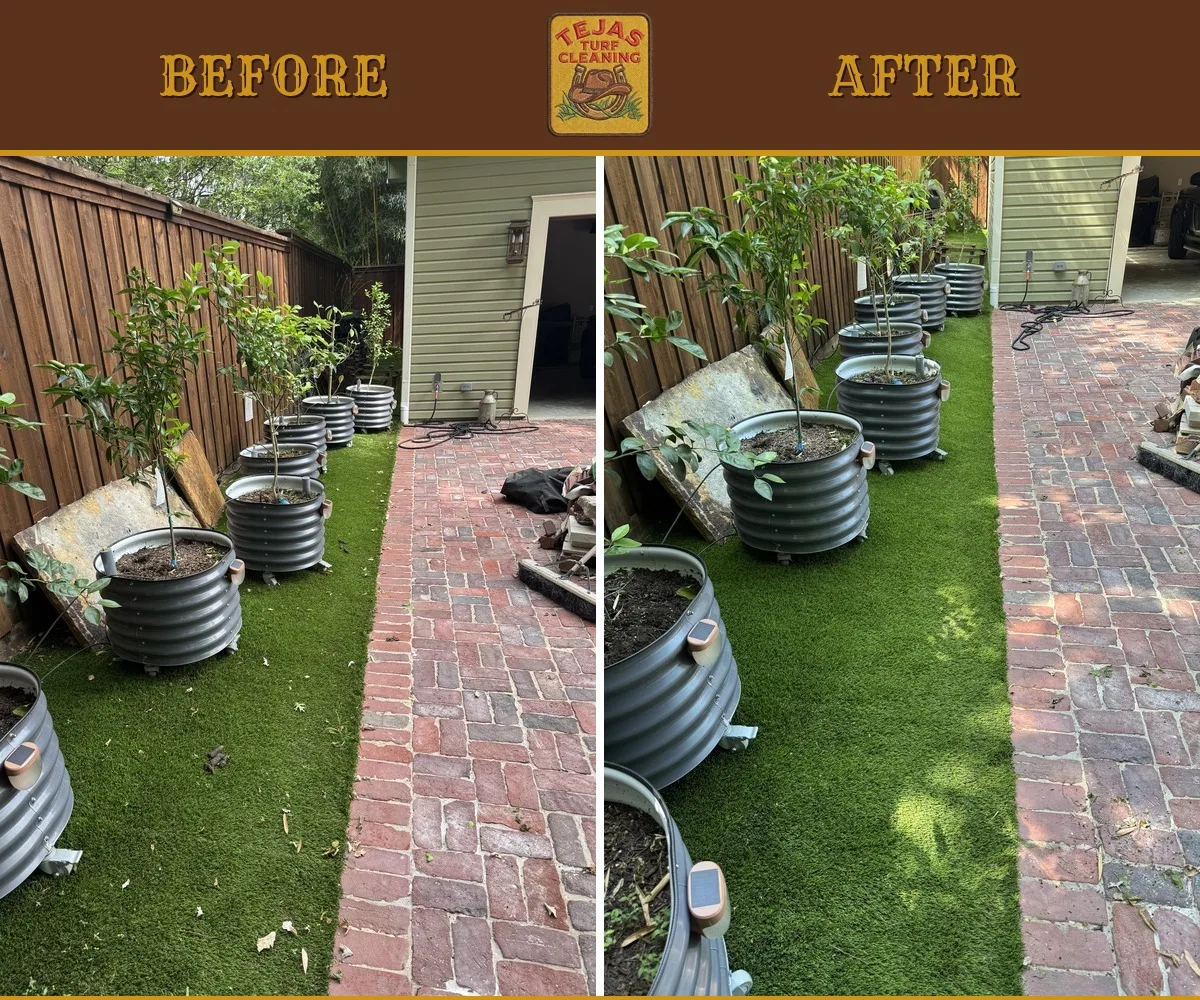
Houston's rainfall patterns do something unique to artificial turf infill that most homeowners don't fully understand until they see the evidence in their yard. The city averages over 50 inches of rain per year — consistently the highest of any major Texas metro — delivered in high-intensity events that move water across turf surfaces at volumes the drainage system wasn't always designed to handle efficiently. Each significant rain event moves infill. Repeat those events dozens of times per year, and the cumulative displacement adds up to a measurable problem: thin spots, compacted zones, drainage failures, and blade support loss that shows up as flat, matted-looking turf long before any fiber damage occurs.
Infill replenishment is the service that addresses this displacement and compaction directly — restoring infill to proper depth and distribution, recovering drainage performance, and reestablishing the cushion and blade support your turf requires to perform correctly. It's a service that Houston turf owners need more frequently than homeowners in drier Texas markets simply because of the rainfall volume moving through their turf. Get a free quote for your property.
Why Houston Turf Loses Infill Faster
Infill displacement is a universal turf maintenance issue, but Houston's specific conditions accelerate it in three ways that set the Gulf Coast market apart from drier Texas regions.
High-volume, high-intensity rainfall. Houston regularly receives 3–5 inch rainfall events from tropical systems, frontal systems, and convective storms. These events move water across turf surfaces fast enough to physically migrate infill toward drainage edges and downhill areas. A single significant storm can visibly displace infill toward perimeter drains, creating thin spots in the center of the turf installation and piled areas at the edges.
Frequent wet-dry cycles compact remaining infill. Houston's rainfall isn't evenly distributed — intense rain events are followed by drying periods where the saturated infill settles and compacts. Each wet-dry cycle compresses the infill slightly more. Over a season of 20–30 significant rain events, the cumulative compaction is substantial. Compacted infill loses its drainage performance, its cushioning function, and its ability to support blade structure effectively.
Humidity-driven particle binding. Houston's year-round humidity creates a persistent moisture film on infill particles that causes them to bind together more aggressively than in drier climates. This binding makes compaction more complete and harder to address with surface grooming alone. Compacted Houston infill requires physical decompaction and often replenishment to restore original performance characteristics.
Signs Your Houston Turf Needs Infill Replenishment
Visible thin spots or bare areas. If you can see the turf backing through the blades in certain zones — particularly near edges, around drains, or at the low points of your installation — significant infill displacement has occurred. These bare zones provide no cushion and allow turf fibers to be walked flat directly onto the backing, accelerating wear.
Water pooling after rain. When infill compacts and drainage perforations become blocked by settled contamination, water that should drain through the backing instead sits on the surface. Houston's heavy rain events make drainage failure immediately visible. If your turf pools for more than 30 minutes after rain stops, infill and drainage restoration is overdue.
Flat, matted-looking turf that doesn't respond to brushing. Turf that looks matted despite regular brushing typically has insufficient infill to support the fiber blades upright. The infill is what keeps blades standing — without adequate depth, fibers lie flat regardless of how frequently you groom them.
Reduced cushioning underfoot. Your turf should feel resilient and somewhat springy underfoot. When it starts feeling hard or thin — like walking on compacted mat rather than turf — infill depth has dropped below the threshold needed for cushion function. This is particularly noticeable in high-traffic zones like play areas, pet runs, and entry paths.
Our Infill Replenishment Process
We begin with a thorough infill depth assessment — measuring infill depth at multiple points across the full installation to map thin zones, identify displacement patterns, and determine the volume of material needed. Houston installations typically show the most significant thinning near perimeter drains and at the downhill edges of the installation — the drainage flow paths that high-intensity rain events create.
Surface preparation includes debris removal and initial power brushing to raise flattened fibers and expose the existing infill surface. In most cases, we combine infill replenishment with a partial or full deep clean to ensure we're adding fresh infill on top of a clean, decompacted base rather than on top of contaminated, compacted existing material.
Infill selection is a genuine choice with meaningful performance implications. For Houston properties, we recommend either standard silica sand (economical, proven, good drainage performance) or antimicrobial-treated infill for pet-use areas (adds continuous odor management between professional cleaning visits). For high-sun-exposure properties, we can discuss specialty cooling infill that measurably reduces surface temperatures. We walk through the options at every appointment.
Application and distribution uses specialized equipment to place fresh infill evenly across the identified thin zones and throughout the full installation area, reaching designed depth uniformly. Uneven infill creates drainage problems and inconsistent cushioning — we verify depth at multiple measurement points after application.
We finish with final grooming — power brushing the freshly filled turf to ensure the new infill settles properly around the fiber blades and drainage performance is verified across the full installation.
How Much Does Infill Replenishment Cost in Houston?
Infill replenishment is quoted per job based on your installation's infill type, the depth deficit we measure, and total square footage. We assess your specific infill levels before quoting, so you know exactly what you're getting — no flat-rate guesswork. Request an assessment through our contact form, or bundle it with a deep clean visit.
Frequently Asked Questions About Infill Replenishment in Houston
How often does Houston turf need infill replenishment? Most Houston turf installations need infill assessment at least once a year and replenishment every 1–3 years depending on rainfall exposure, foot traffic, and drainage characteristics of the specific installation. Properties with heavy pet use, pooling issues, or significant visible thinning may need more frequent attention.
Can you replenish infill without a full deep clean? Yes, though we generally recommend combining services. Adding fresh infill on top of significantly contaminated existing infill buries the contamination rather than removing it, which limits the drainage and odor benefits of the replenishment. For properties with moderate contamination, we'll advise on the most cost-effective approach.
Does infill replenishment fix drainage problems? Yes, in most cases. Drainage failure in Houston turf is most commonly caused by infill compaction and contamination blocking drainage perforations in the backing. Deep cleaning followed by infill replenishment restores drainage in the vast majority of installations without any structural modification to the turf system.
Schedule Your Infill Assessment Today
Houston's rainfall volume makes infill replenishment a regular maintenance need rather than an emergency fix. Proactive assessment and replenishment prevents the drainage failures, matting, and performance degradation that become increasingly expensive to address. We serve all 30 Greater Houston communities. Use our online quote form to schedule a free assessment.
Service Overview
Pricing
Includes:
- Infill level assessment
- Silica or antimicrobial sand
- Even distribution
- Drainage restoration
- Blade support optimization
Our technicians follow standards set by the Synthetic Turf Council — the industry's leading authority on synthetic turf care.
Infill Replenishment Near You
We serve all of Greater Houston. Click your city for local pricing and availability.